Gender Pay Gap 2025
Ownership, Transparency and Progress
Since 1953, Stride Treglown has been built on a human approach. For 70 years, we’ve applied this to our buildings and the places we design. As an Employee-Owned Trust, we’re now applying it with the same rigour to how we value our people.
Great design requires ego-free environments where everyone can do their best work. The same is true for our practice. Closing the gender pay gap isn’t just regulatory compliance, it’s fundamental to ensuring every employee owner of this business can contribute and progress equally.
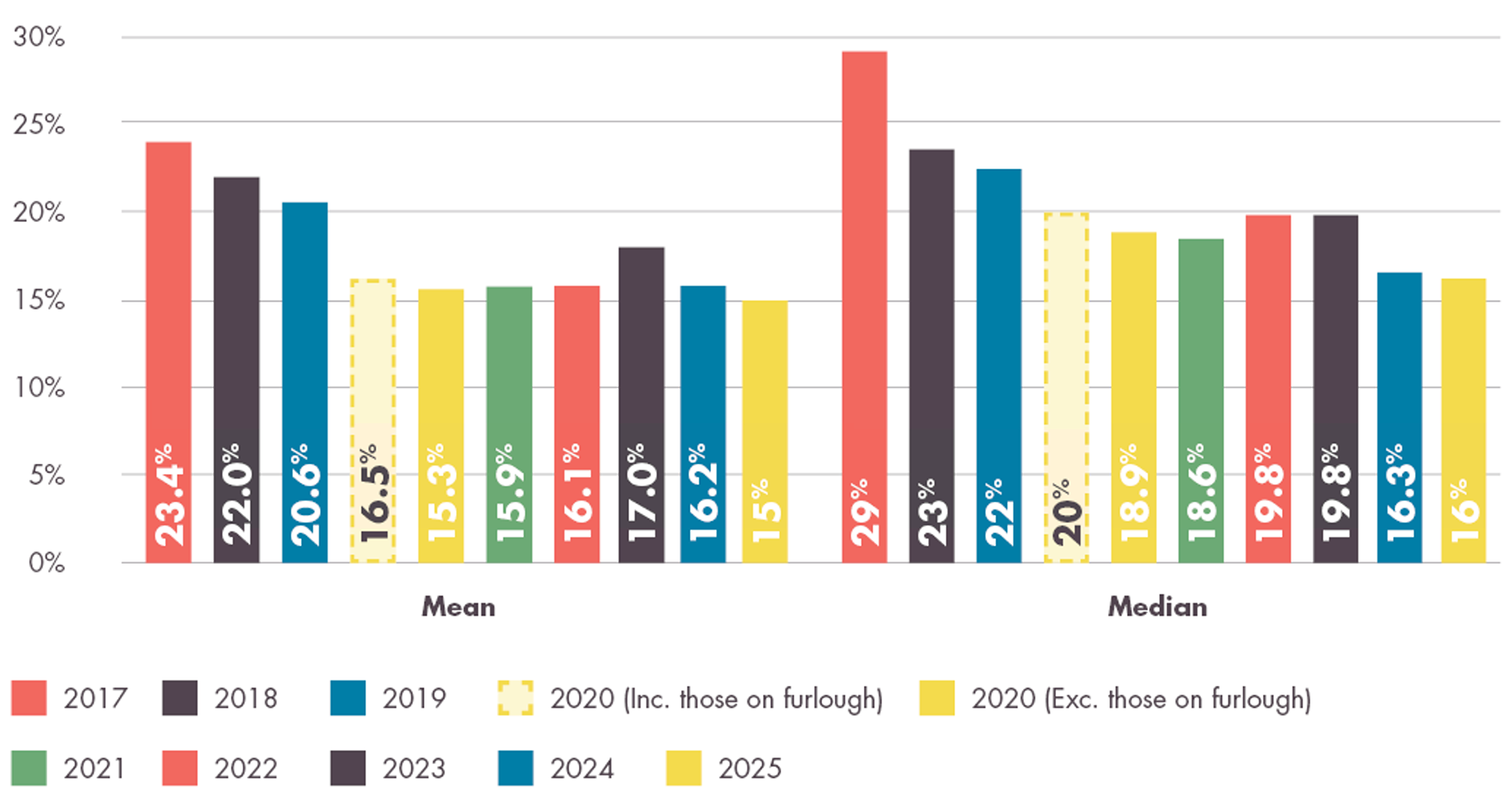
This is our 9th gender pay gap report and shows our continuing work to close our gender pay gap: our mean gap has fallen from 22.8% in 2017 to 15% today, the lowest we’ve ever recorded. Our median stands at 16%, matching our previous lowest score.
This data tells us what works and what we need to improve. It shows us where we’ve made real progress, and where we must focus next. Becoming a 100% Employee-Owned Trust has strengthened our commitment to transparency and fairness, values that also underpin our B Corp recertification and principles.
This report is honest about both our achievements and our challenges. Here’s what we’re learning, and what we’re doing next.
Our Approach – Measuring What Matters
Just as we use data to evaluate how people experience our buildings, we apply the same evidence-based approach to understanding how our colleagues experience working here.
This report isn’t just about regulatory compliance; it’s about honest feedback that drives continuous improvement. Like our ENGAGE listening programme for our clients, we’re gathering data, listening to our Employee Trustees and Forum, and acting on what we learn.
Our B Corp recertification assessed our social impact against independent standards. This gender pay gap report is part of that verified commitment: measuring what matters, being transparent about the results, and taking action based on evidence.
Our commitment to transparency extends beyond our own practice. Through an industry-wide HR Network connecting over 170 architectural practices, we share our policies, learnings and developing plans with practices who may not have the same resources or experience in these areas. We believe that closing the gender pay gap requires industry-wide change, not just internal action, and we are taking every opportunity to influence that change.
What we report:
The gender pay gap shows the difference in average earnings between all men and women in our practice, regardless of their role or seniority. It’s different from equal pay, which compares men and women doing the same or similar work. This is an important distinction for us, as we are also monitoring our equal pay (even though we are not required to publish it) to make sure that role by role, those doing equal work of different genders are paid the same.
We’re required to report:
Mean Gender Pay Gap: The traditional average, calculated by adding all hourly rates and dividing by the number of individuals. The mean can be significantly influenced by outliers, such as higher or lower-paid individuals.
Median Gender Pay Gap: The middle hourly rate when everyone is lined up from lowest to highest paid. We focus on the median as it’s less likely to be influenced by outliers and less prone to fluctuations caused by high or low earners, making it a more representative figure. The median is commonly used when comparing salaries and gender pay gaps across different companies.
Bonus Gap: The difference between male and female colleagues who received a bonus from May 2024 to April 2025.
Pay Quartiles: Our workforce divided into four equal groups from lowest to highest paid, showing the gender split in each.
Our 2025 Results – Nine Years of Progress
Hourly Pay Gap
This represents our progress since we began reporting in 2017.
Nine years of consistent measurement shows clear progress. Our mean gender pay gap has fallen by 7.8 percentage points, whilst our median has improved from 2017 figure to 16% today.
This change reflects the adjustments we made during through our promotion and salary review processes across all levels of the practice, including senior-level promotions during that time. Our gender-balanced Promotion & Salary panel, annual role-on-role salary comparisons, and equal pay audits help us maintain momentum.
(down from 22.8% in 2017)
(joint lowest since we began reporting)
Context:
The UK median gender pay gap across all industries was 14.3% in 2024 (ONS). For architecture specifically, our 16% median compares to an approximate sector average of 17% (RIBA Business Benchmarking Survey 2025 Report). Given the historical underrepresentation of women in senior architectural roles, our sustained progress demonstrates the impact of action, and we know we have further work to do.
Our Demographics – The Bigger Picture
Overall gender split
(April 2025)
Stride Treglown’s Architects
(2025 demographic)
ARB Register
(Feb 2026)
Tenure and Progression
Average tenure: 9 years
As employee-owners, our colleagues have an average tenure of 9 years. This shows the ownership model creates commitment but also means we must be intentional about progression as roles become available.
With approximately 9% natural annual employee turnover for all employees (including our Graduate Part 1 Architectural Assistants), senior-level change is gradual. This makes our structured approach to promotions and succession planning essential, ensuring opportunities are visible and decisions are fair when positions do become available.
Our Studios
Deep local knowledge has been part of our approach since 1953. Our female studio leads demonstrate that senior leadership is possible across our regional studios, not just in one location. We’re committed to ensuring career progression doesn’t require relocating, supporting both our business model and the diverse needs of our people.
Part-Time and Flexible Working
Whilst the architecture profession has historically lost senior female talent due to a lack of flexible senior roles, our practice demonstrates strong uptake of flexible working among female colleagues, including at senior levels.
27% of women in Quartile C (second highest paid) work flexible or reduced hours
18% of women in Quartile D (highest paid) work flexible or reduced hours
The option to work reduced or compressed hours is available to all colleagues.14% of men in Quartiles C and D work flexibly, demonstrating this isn’t a gendered benefit but a genuine option for all.
Retention Post-Parental Leave
In 2024, 100% of women (5 colleagues) returning from maternity leave remained with the practice after 12 months. This demonstrates that our enhanced parental support and flexible working policies enable people to continue their careers after becoming parents. This means more men are taking leave after becoming parents, sharing the parenting load from day one. This is important in challenging assumptions around women being the main care givers from day one.
Ethnicity, Disability and Intersectionality
Closing the pay gap requires us to look beyond gender alone. We monitor our ethnicity pay gap internally and are working towards a position where this can be reported publicly. We are currently awaiting clear government guidance on data subdivision before making this public and have recently reviewed our ethnicity groupings to ensure our data accurately reflects how our colleagues wish to be identified.
We are also aware that disability, particularly neurodiversity, is likely underrepresented in our declared workforce data. We recognise that not all colleagues choose to share disability-related information, and we believe the true picture within our practice is broader than our declared figures suggest. Planned awareness work during 2026 /2027 will help us better understand and respond to this.
Our commitment to understanding these issues in their full complexity is reflected in our participation in external research, including a recent study by UWE into intersectionality in the architectural workplace.
What the Evidence Shows – Actions and Impact
Like our post-occupancy evaluations, this data tells us what’s working and where we need to improve. Here’s what we’ve learnt from nine years of measuring, and the actions we’ve taken in response.
1. Gender-Balanced Decision Making
What we’ve done
- Established gender-balanced Promotion & Salary review panel
- Conducted annual role-on-role salary comparisons across the practice
- Completed equal pay audits to identify and address unjustified gaps
- Completed equal promotion audits to identify and address unjustified gaps
- Opened senior recruitment via internal advertisement before external search
Moving towards pay transparency
In November 2024, we launched our Reward Strategy, committing to move towards greater pay transparency. We have spent several years aligning roles and clarifying grades and salary titles, work that the Board reviewed in November 2025, with next steps planned for the next few months. We have developed internal business intelligence reporting to benchmark against local and national pay data, ensuring our decisions are evidence-based.
Fairer Recruitment
We do not ask salary history questions during our recruitment process. Instead, we ask about salary expectations for the new role, removing a well-documented driver of pay disparity by gender and ethnicity. We do not have clauses in contracts preventing colleagues from discussing their salaries with one another.
From March 2026 we have invested in Workable, a recruitment platform that supports a consistent and structured approach to hiring. All interviewers complete bias awareness training before participating in recruitment decisions, and we use gender-balanced interview panels wherever possible. We are actively working towards publishing salary ranges on external job adverts once our internal transparency bands are established.
All of our roles are advertised externally as flexible by default, with our Flexible, Agile and Hybrid Working policy available on our website, unless there is an explicit business reason requiring specific arrangements related to a project workload.
2. Enhanced Parental Support
What we offer (enhanced November 2024):
- 4 months full maternity pay
- 1 month full paternity pay
- Paid time off for fertility treatment
Our declared commitment we are working towards:
- Increase to 6 months full maternity pay
- Increase to 3 months full paternity pay
Supporting colleagues through parenthood
We have published ‘A Balanced Art: Becoming a Parent’ — guidance developed directly with the input and feedback of our colleagues, offering a comprehensive and personalised approach to supporting employees through parenthood. We will review this against the UrbanistasNW ‘Careers, Kids and Caring Responsibilities Toolkit’ by the end of Q2 2026 to ensure we are drawing on all available best practice.
We are closely monitoring the Employment Rights Act (April 2026), which will introduce day-one paternity rights, and are preparing our policy updates accordingly.
Our exit interview process means we track whether parental leave or return-to-work experiences contribute to any colleague’s decision to leave the practice, enabling us to act directly on that data.
Impact:
In 2024/2025, 8 fathers took paternity leave.
100% of women who took maternity leave in 2024 returned to the practice and remain in post.
Flexible return-to-work arrangements available, with many senior women working reduced hours whilst maintaining career progression.
During the pregnancy, we were worrying about how much time and money we’d have. When the change came in just after my daughter was born, it meant we could save for a trip to Tuscany, where our daughter got to meet her Italian family.
Erin Porrington, Bid Co-ordinator
3. Inclusive Leadership Development
- Launched GROW learning and development programme in 2021.
- Delivered Associate training programme.
- All colleagues have access to mentoring and coaching.
- Implemented Lattice platform to capture conversations, feedback, and professional growth plans giving individuals a stronger voice in their own development and career paths.
- Rolled out Strength Scope assessment tools to help teams understand each other better.
- Delivered inclusion and diversity training across all levels through our mandatory Thursday 60 training series, which includes annual EDI content and refresher training on appropriate behaviours and harassment prevention.
Contributing to the wider profession
Our colleagues have actively contributed to the wider profession through Women in Architecture speaker events in 2025, sharing personal experiences of career progression, flexible working and parental leave. Several colleagues are lined up to mentor through the Women in Architecture 2026 programme within universities. We also engage with The Mentoring Circle and RIBA/CIAT mentoring schemes within universities, and time spent on external mentoring outside usual working hours can accrue against flexitime.
We believe that the most meaningful change happens when we share what we know, not just improve internally.
4. A Safe and Respectful Workplace
- Creating conditions where everyone can progress equally requires more than good pay policies. It requires a culture where everyone feels safe and respected.
- A sexual harassment risk assessment using the TUC Risk Assessment has been shared with studios as a tool for raising awareness and preventing harassment, both within our practice and by third parties. We are working with studios to make this more rigorous and more visible by the end of 2026, in line with the requirements of the Employment Rights Act.
- Reviewed and updated our Bullying and Harassment Policy in Autumn 2024 as part of our response to the Worker Protection Act, with training completed for all colleagues at that time.
- Included harassment awareness as part of our mandatory Thursday 60 HR refresher training for all colleagues in April 2025, with a plan to repeat this annually.
- Provided additional training for the Senior Leadership Team specifically on inclusive behaviours and understanding context.
Managing working hours fairly
We have a flexi day and TOIL system that gives colleagues the opportunity to reclaim time when they need to work extended hours, whether in the office or at home. We have structures to record out-of-hours work in any location. Compliance with the European Working Time Directive is audited quarterly by our People & Development team, with excessive hours flagged to Regional Directors so that our colleagues can be supported to address this.
Hybrid and Flexible Working
Our Hybrid Working policy has been in place since 2020, offering flexible and blended working as a day-one benefit. Given that this policy has been in place for several years, we are committed to reviewing it during 2026/27 without changing its fundamental premise of trusting colleagues to choose the most appropriate place of different types of work to ensure it remains fit for purpose and reflects any new areas of learning.
The move to an EOT gives us all a stronger voice in how we run the practice.
Rebecca Draper, Senior Associate Head of
Knowledge Management and EOT Trustee
5. Employee Ownership & Voice
How it works:
100% Employee Owned Trust since March 2025, and our journey to an EOT started in 2016 with employees being able to buy shares within the practice.
Employee Trustees and Forum representatives actively shape our approach to closing the pay gap.
Colleagues hold leadership accountable as genuine stakeholders, not just employees.
External Accountability
Our accountability extends beyond our own governance structures. As participants in the Bristol Women in Business Charter and peer-to-peer organisation mentoring, we hold ourselves to external standards as well as internal ones. Our B Corp certification requires public transparency on our commitments, this report is part of that verified accountability.
6. Wider EDI Commitments
Closing the gender pay gap sits within a broader commitment to an equitable and inclusive practice.
This includes:
- Rachel Bell, EDI Director, holds protected time for EDI within her Board Director role and is currently Chair of the National Women in Property Board, bringing external expertise to bear internally. She is supported day-to-day by Sean Peacock, our Head of HR, and Caroline Mayes, our People and Development Director
- Mandatory annual EDI training for all colleagues through our Thursday 60 programme, including specific content on appropriate behaviours, harassment prevention and inclusion
- Internal mentoring available to all colleagues, complemented by engagement with Women in Architecture, The Mentoring Circle, and RIBA/CIAT external schemes
- Participation in external research including a recent UWE study into intersectionality in the architectural workplace
- Stride Together group actively reviewing our external communications and company website to ensure they reflect our inclusive values
- Social events designed from the bottom up across studios to be accessible and attractive to all colleagues, with manager training on inclusive event planning
7. Commitments to our colleagues
- Living Wage Employer accredited
- Disability Confident Committed
- Health cash plan for all colleagues
- Enhanced study leave and bursaries (up to £3,000)
- Long service recognition (10+ years and 20+ years)
- Paid time off for fertility treatment
Pay Quartiles – The Detail
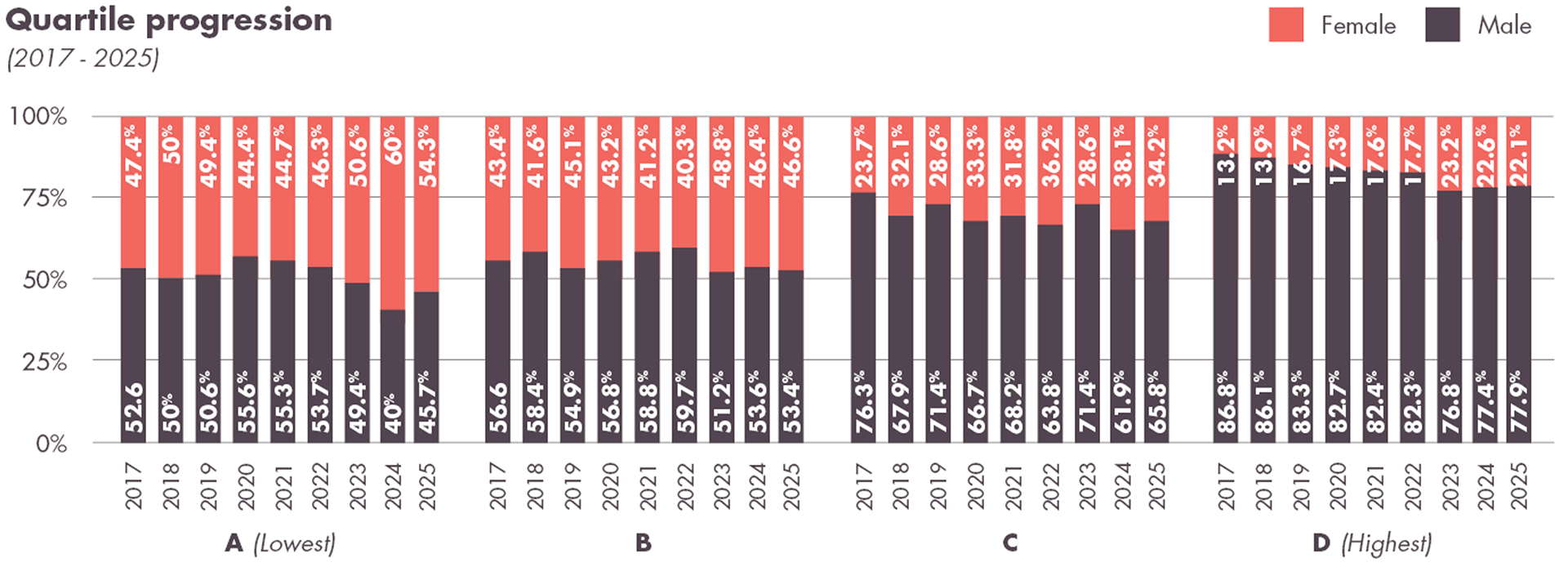
Pay quartiles divide our workforce into four equal groups from lowest to highest paid, showing the gender distribution in each.
A (Lowest)
B
C
D (Highest)
What this tells us
Quartiles A & B now approaching 50/50 balance, with Quartile A showing 54.3% female representation. This reflects our successful recruitment of female graduates demonstrates that women are now entering our practice in increased numbers.
Small fluctuations in headcount can cause percentage changes in these quartiles, but the overall trend shows balanced recruitment and early-career progression.
Quartile C shows 34.2% female representation, a drop from the near-parity of Quartiles A and B.
This indicates that progression from mid to senior levels requires continued focus, it is the stage in a career where caring responsibilities most often fall, and where flexible working and visible progression pathways matter most.
Quartile D represents our greatest challenge and our most important progress:
- 22.1% female in 2025 (up from 13% in 2017).
- This quartile contains 17 women and 60 men.
- 18% of women in this quartile work flexible or reduced hours during 2025.
Bonus Pay Gap
2025 Bonus Data
Proportion receiving a bonus
(May 2024 to April 2025)
Bonus pay gap
Understanding Our Bonus Approach
Our bonus structure includes:
- Discretionary profit-related bonuses
- Performance-related recognition payments
- Equity director profit-sharing mechanism
Why Bonus Pay Gaps Exist
Eligibility gap (91.9% vs 86%):
Eligibility for profit-related bonuses depends on being at the practice during the previous financial year. Our intake of female talent in late 2024/early 2025 means some colleagues (including females) weren’t yet eligible for the 2024 summer company discretionary profit-related bonus, which partially explains this gap.
Bonus amount gap:
The bonus amount gap primarily reflects:
- Tenure-related eligibility for certain bonus schemes
- The underrepresentation of women in Quartile D (highest paid roles attract higher bonuses)
Current director split (2025): 4 of 15 directors are women.
In the recent report commissioned by the RIBA, ‘Build it Better’, the Fawcett Society has identified the bonus gap as an underexplored driver of the gender pay gap in architecture, and we take this seriously. As our practice transitions fully to an Employee Ownership Trust, our bonus structures are being actively reviewed. We are committed to greater transparency around bonus distribution during 2026/27, and our Employee Trustees are engaged in this process.
What We’re Improving – Learning from the Data
The evidence shows us three clear priorities for 2025-26:
1. Quartile D Representation Remains Our Biggest Challenge
Current: 22.1% female in highest-paid quartile
Actions for 2025-26:
Implement structured succession planning with visibility of progression pathways
Target: Achieve 30% female representation in Quartile D by 2028
Accountability: Annual progress reviews by Employee Trustees
2. Progression Pathways Must Be More Visible
Learning: Feedback from colleagues indicates that progression criteria and opportunities could be clearer, particularly for moves from Quartile C to D.
Actions for 2028:
- Publish clear progression tracks for all career levels by 2028
- Implement transparent role profiles with salary ranges
- Ensure all senior vacancies are internally advertised before external search
- Expand mentoring programme with focus on career progression
- Use 1:1 conversations, feedback, and development plans to improve promotion decisions
Target: 100% of colleagues to have documented career conversation and development plan by end of 2027
Accountability: Monitored and reviewed by team leaders and across the practice.
3. Bonus Transparency and Equity
Actions for 2025–26:
- Review bonus eligibility criteria in line with our EOT transition.
- Publish a clearer framework for how bonus decisions are made under our new EOT.
- Monitor and report on bonus gap annually alongside pay gap data.
Our Position on Industry-Wide Change
Closing the gender pay gap in architecture cannot be achieved by individual practices alone. As one of the profession’s larger employers, we believe we have a responsibility to advocate for change beyond our own walls.
Through the industry-wide HR Network we participate in, we connect with and support over 170 architectural practices, sharing policies, learnings and developing plans that smaller practices may not have the capacity to develop independently. We also share our experience through the Bristol Women in Business Charter and peer-to-peer organisation mentoring.
Based on nine years of measuring and acting on our own data, we believe the following changes would accelerate progress across the profession:
- The gender pay gap reporting threshold should be lowered from 250 to 50 employees, ensuring that the many smaller practices which make up the majority of the architecture profession are held to the same standards of accountability.
- Limited Liability Partnerships should be required to include all directors and partners in their reported data. Currently, the structure of LLP reporting creates a significant gap in the profession’s understanding of senior-level pay. Our data includes all our colleagues, including all directors.
- Salary ranges should be published on all job adverts as a requirement, not a recommendation. We are working towards this ourselves and believe it should become standard practice across the sector.
- Ethnicity and disability pay gap reporting should be made mandatory, with clear government guidance on data subdivision to ensure reporting is meaningful and consistent
- Enforcement rules around reporting and action plans should be further strengthened so that publishing data leads to genuine accountability
Accountability and Governance
Director Pay Equity
- Director : Lowest paid ratio = 5:1
- Director : Median pay ratio = 3:1
- Male and female directors are paid equally based on location and role
- We conduct regular benchmarking to ensure director pay remains fair and competitive
How We Stay Accountable
Our EOT structure creates multiple layers of accountability:
Internal governance:
- Quarterly pay gap monitoring by Board and Leadership Team.
- Annual equal pay audit conducted internally.
- Employee Trustees review progress against all commitments.
- Employee Forum has standing agenda item on pay equity.
- Regular updates published on internal communications channels.
External verification:
- B Corp recertification reviews our social impact practices
- Living Wage Foundation accreditation
- Bristol Women in Business Charter
- Greater Manchester Good Employers Charter
- Gender Pay Gap reporting published annually on gov.uk and our website
In Summary
For 70 years, Stride Treglown has demonstrated a human approach to design. We measure post-occupancy. We ask clients for honest feedback. We became B Corp. We became an Employee Owned Trust.
This gender pay gap report is the logical extension of everything we already do: evidence-based, human-centred, locally grounded, ego-free, and committed to verified improvement.
What the evidence shows:
- Continued improvement and decrease to our gender pay gap, a journey we began reporting on from 2017.
- Mean gap: 15% (down from 22.8%).
- Median gap: 16% (joint lowest).
- Real progress in senior female representation (13% to 22.1% in Quartile D).
- Strong retention of women post-parental leave.
- Flexible working available and used at all levels by both men and women.
What we must improve:
- Quartile D representation remains below where it should be
- Bonus eligibility and amount gaps require action
- Progression pathways need greater transparency
Declaration
We confirm that the information and data provided in this report is accurate and in line with the Equality Act 2010 (Gender Pay Gap Information) Regulations 2017.
Pierre Wassenaar
Chair
Stride Treglown is an Employee Owned Trust, B Corporation, Living Wage Employer, and Disability Confident Committed employer.
